TR
TR



What is All-on-4 and All-on-6 Implant Treatment?
All-on-4 and All-on-6 implant treatments are modern implant concepts developed to provide fixed dental restorations for patients with complete tooth loss. In these methods, 4 or 6 implants are placed in the jawbone, and fixed prosthetic teeth are applied on top. The goal is to offer a stable, aesthetic, and functional alternative to removable dentures.
Full-arch implant treatments are planned individually. No final decision is made without evaluating bone volume, overall health, and jaw anatomy.
What Are the Benefits of All-on-4 and All-on-6 Treatments?
These treatments:
-
Provide a fixed dental solution in cases of complete tooth loss
-
Improve chewing function
-
Support speech comfort
-
Eliminate the need for removable dentures
-
Help slow down bone loss in the jaw
They offer an important alternative, especially for older patients seeking fixed teeth.
Alternatives to Traditional Dentures in Complete Tooth Loss
Traditional full dentures:
-
Can be removable
-
May cover the palate
-
Adaptation process can be difficult
All-on-4 and All-on-6 implant systems:
-
Integrate into the bone
-
Provide a fixed structure
However, suitability varies for each patient.
Key Features of All-on-4 and All-on-6 Treatments
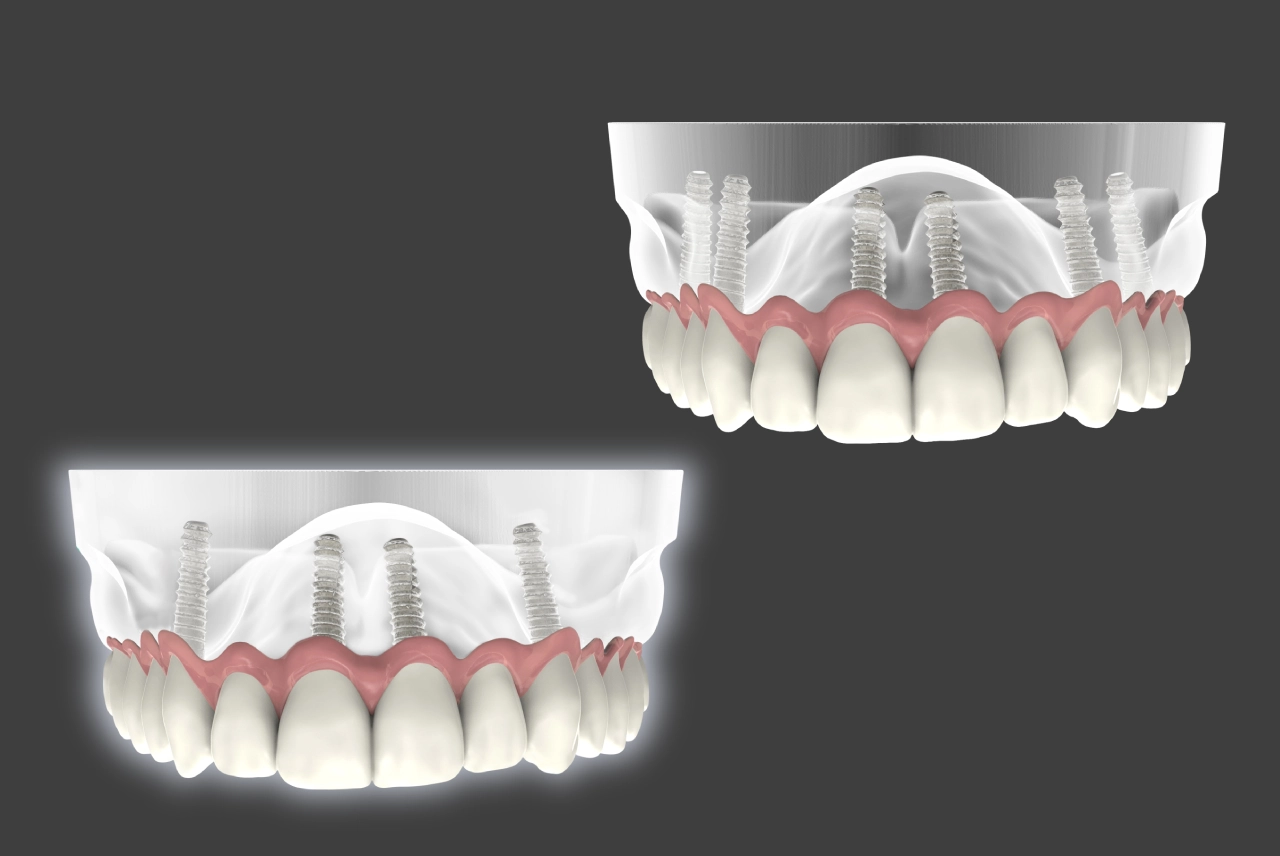
Number of Implants and Placement Angle
-
All-on-4 implants:
-
4 implants are used
-
Posterior implants may be angled
-
Can reduce the need for bone grafting
-
-
All-on-6 implants:
-
6 implants are used
-
Provides a wider support area
-
May offer more balanced load distribution in some cases
-
Implant placement planning is performed with 3D imaging.
Same-Day Fixed Teeth
In suitable cases, temporary fixed teeth can be placed on the same day.
However, this depends on:
-
Bone stability
-
Primary implant stability
-
Overall health status
Not all patients receive permanent teeth on the same day.
Healing Process and Follow-Up
The process of osseointegration may take several months. During this period:
-
Temporary dentures are used
-
Regular check-ups are scheduled
-
Oral hygiene is critical
Healing time varies depending on individual factors.
Differences Between All-on-4 and All-on-6
-
Number of implants
-
Load distribution
-
Bone volume requirements
-
Long-term stability planning
Both methods provide full-arch implant solutions; the choice depends on the patient’s anatomical structure.
When to Choose Which Treatment?
-
All-on-4 may be preferred if bone volume is limited
-
All-on-6 can be planned if there is stronger bone support
-
More implants may provide advantages in cases like bruxism (teeth grinding)
The final decision is made after clinical evaluation.
Who is Suitable for All-on-4 / All-on-6?
-
Patients with complete tooth loss
-
Patients who have lost most of their teeth
-
Those who do not want to use removable dentures
-
Individuals with sufficient jawbone volume
Bone Structure and General Health Assessment
Suitability is evaluated based on:
-
Jawbone density
-
Systemic diseases
-
Smoking habits
-
Oral hygiene
Treatment may be postponed in uncontrolled diabetes or active infections.
Advantages of All-on-4 Treatment
-
Comfort of fixed teeth
-
Faster functional recovery
-
Alternative to removable dentures
-
Opportunity for aesthetic smile design
Success depends on proper case selection and patient compliance.
Patient Experience and Treatment Process
The treatment process generally includes:
-
Clinical examination and imaging
-
Digital planning
-
Surgical implant placement
-
Temporary fixed teeth (in suitable cases)
-
Healing period
-
Permanent prosthesis placement
A multidisciplinary approach can increase patient satisfaction.
Factors Affecting Treatment Success
-
Surgical technique
-
Implant quality
-
Bone density
-
Regular follow-up
-
Oral hygiene
-
Smoking
Results vary individually and cannot be guaranteed.
Future of All-on-4 and All-on-6 Treatments
Thanks to technological advances:
-
Digital surgical guides
-
More precise planning
-
Accelerated healing protocols
However, technological progress does not eliminate the need for expertise.
Frequently Asked Questions
-
Are teeth placed on the same day? Temporary fixed teeth may be applied on the same day in suitable cases, but permanent prostheses require a healing period.
-
When are permanent teeth applied? Usually planned a few months after bone integration; timing varies per patient.
-
Who is not suitable? Patients with insufficient bone, uncontrolled systemic diseases, or poor oral hygiene may have limited suitability.
-
What determines the cost? Number of implants, brand used, additional surgical procedures, and prosthetic materials affect prices.
-
Is the treatment permanent? With proper care and regular check-ups, implants can last many years, but exact duration depends on individual factors.
Summary
All-on-4 and All-on-6 implant treatments are modern solutions providing fixed teeth for patients with complete tooth loss. Planning is based on the number of implants and bone structure. Proper patient selection and regular follow-up are critical for success.